
 0
0



BLOG
- Home
- Blog
- Technical Articles
- Comprehensive Guide to Lathes in Metalworking Factories: CNC, Turn-Mill, and Swiss-Type Machining
Comprehensive Guide to Lathes in Metalworking Factories: CNC, Turn-Mill, and Swiss-Type Machining
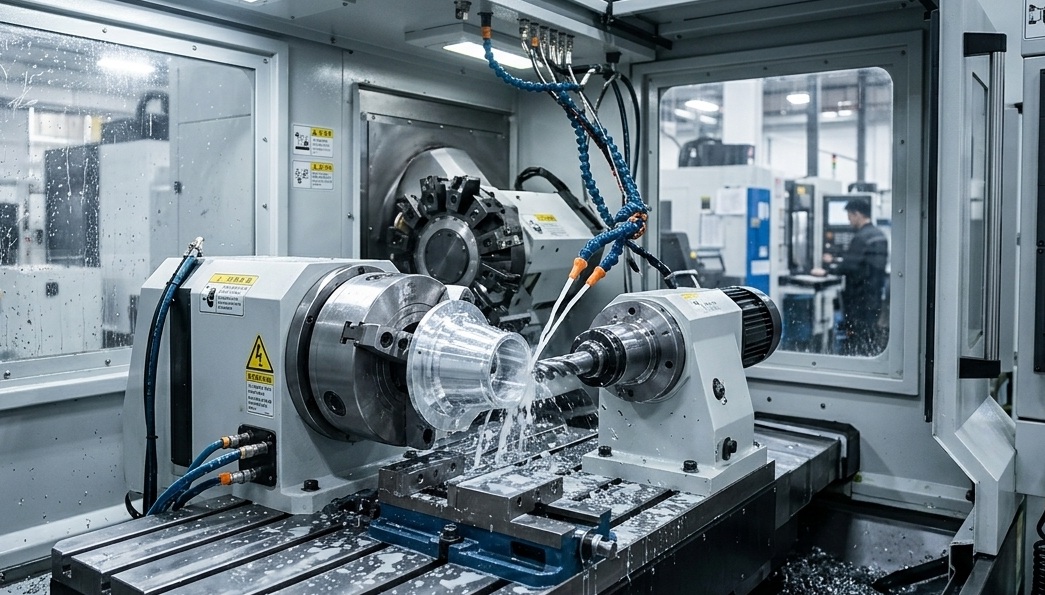
前言 (Meta Description/Intro): When evaluating a metalworking factory's manufacturing capabilities, the lathe machining equipment on the shop floor is the key factor determining production efficiency, lead time, and precision. Different part dimensions, materials, and production volumes require specific types of lathes. This article provides a comprehensive overview of four major types of lathes—from conventional manual machines to advanced CNC lathes and Turn-Mill centers—helping you understand their manufacturing advantages and applications for your custom metal fabrication needs.
1. Conventional & Manual Lathes
While lacking automated programming, conventional lathes remain indispensable foundational equipment in specific metalworking scenarios.
Engine Lathe / Center Lathe
The integration of CNC systems is the core technology for modern metalworking factories to achieve standardization and stable production capacity.
2.1 CNC Flat Bed Lathe
For complex geometries and highly stringent precision requirements, multi-tasking equipment drastically reduces production costs and defect rates.
3.1 Turn-Mill / Mill-Turn Center
Specialized machining equipment built for parts with unique specifications or large-scale manufacturing.
4.1 Swiss-Type CNC Lathe / Sliding Headstock Lathe
1. Conventional & Manual Lathes
While lacking automated programming, conventional lathes remain indispensable foundational equipment in specific metalworking scenarios.
Engine Lathe / Center Lathe
- Machining Features: Highly dependent on manual feed operations and the machinist's practical experience. The machine structure is simple, offering extreme versatility and flexibility.
- Target Applications: Ideal for custom single-part fabrication, machinery maintenance/repair parts, new product prototyping, and extremely low-volume metal parts production.
The integration of CNC systems is the core technology for modern metalworking factories to achieve standardization and stable production capacity.
2.1 CNC Flat Bed Lathe
- Machining Features: Combined with advanced CNC control systems, it offers highly stable automated machining capabilities and excellent load-bearing capacity.
- Target Applications: Specifically designed for cutting medium-to-large workpieces and heavier metal materials.
- Machining Features: Features a slanted bed design (typically 30° to 45°) for box ways or linear guideways. The biggest machining advantage is exceptional chip evacuation, preventing chip entanglement. It also offers high structural rigidity and a compact footprint.
- Target Applications: Perfect for automated machining of small to medium parts that require high precision and long, stable operating hours.
For complex geometries and highly stringent precision requirements, multi-tasking equipment drastically reduces production costs and defect rates.
3.1 Turn-Mill / Mill-Turn Center
- Machining Features: Seamlessly combines the rotational cutting of a lathe with the driven tools (milling) of a milling machine. The ultimate process advantage is "One-Hit Machining" (Done-in-One). A workpiece only needs to be chucked once to complete turning, side milling, drilling, and tapping sequentially.
- Target Applications: The ultimate solution for precision parts manufacturing with complex profiles. It significantly reduces cumulative tolerances and human errors caused by repeated re-chucking.
- Machining Features: The machine is equipped with both a main spindle and a sub-spindle. Once the main spindle finishes machining the first side, the sub-spindle can directly grab the part to perform back-end turning and parting-off seamlessly.
- Target Applications: Drastically reduces loading/unloading time, making it an excellent asset for boosting mass production efficiency of high-end hardware components.
Specialized machining equipment built for parts with unique specifications or large-scale manufacturing.
4.1 Swiss-Type CNC Lathe / Sliding Headstock Lathe
- Machining Features: Features a unique design where the material moves back and forth, and the cutting tools operate extremely close to the guide bush. The machining process generates minimal vibration, enabling micron-level precision cutting.
- Target Applications: Essential for long, slender, and micro precision parts with a large length-to-diameter (L/D) ratio, such as medical devices and electronic components. It is the core machinery for precision metalworking factories.
- Machining Features: The spindle points vertically upward, and the workpiece is clamped horizontally on a rotary table. This design effectively overcomes workpiece deformation caused by gravity.
- Target Applications: Exclusively used for extremely heavy, large-diameter, and short-height disc or ring components (e.g., aerospace and heavy machinery parts).

MACRO FOREST
We focus on semiconductor equipment, precision metal processing, and automation components, sharing industry technologies, manufacturing trends, and real-world applications in a simple and easy-to-understand way.

Article Classification
Recent Articles
- Comprehensive Guide to Lathes in Metalworking Factories: CNC, Turn-Mill, and Swiss-Type Machining
- [Complete Guide to Metal Surface Treatment] Guide to Selecting 4 Major Processing Techniques, Characteristics, and Applications
- Smart Automation Insights
- Driving Manufacturing Upgrades Through Smart Automation